
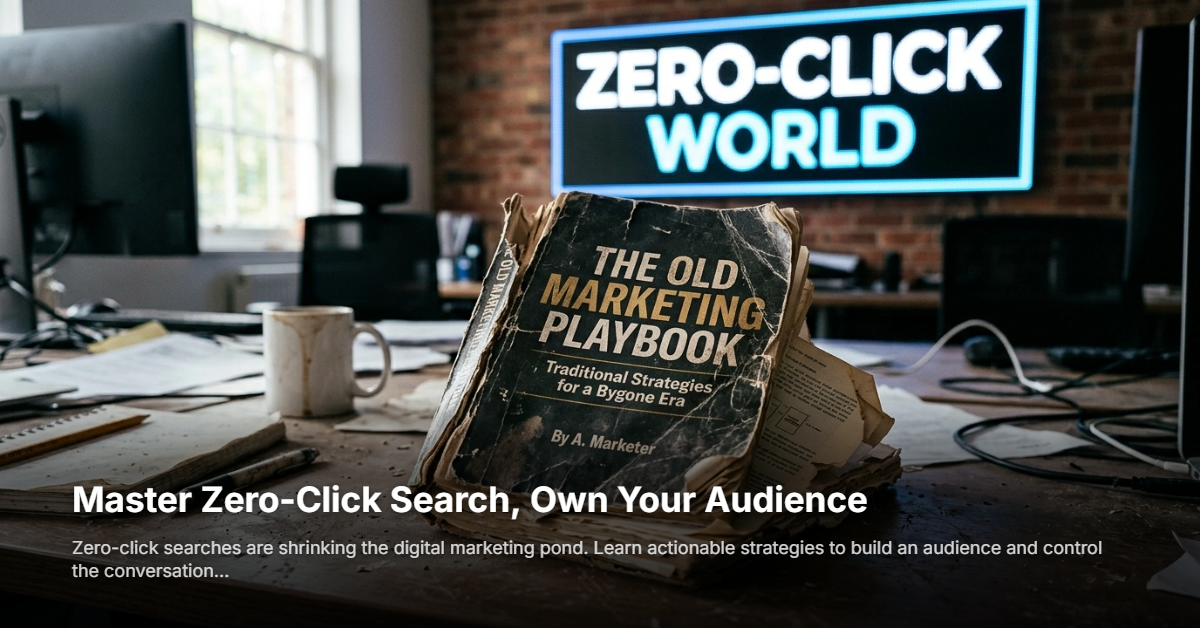
Master Zero-Click Search, Own Your Audience
Zero-click is dominant: 58.5% of Google searches end without a single website visit.[source]
Build on-platform audiences: Engage communities directly on LinkedIn, Reddit, and YouTube instead of chasing clicks.
Own your email list: Email is the one channel no algorithm can take away from you [source].
Track sentiment, not just traffic: Brand mentions, share of voice, and engagement are the reliable success signals now.
Use a unified system: Tools like Linkloom centralize SEO and AEO efforts across every platform where buyers research [source].
Let’s talk about the "zero-clicks." It’s just a simple way of saying that clickable search results, the kind that actually bring people to your website, are getting ridiculously hard to find. A wild 58.5% of all Google searches are now zero-click. That means the searcher finds their answer right there on the results page and never, ever visits a website. It’s even grimmer in the U.S. Only about 36% of searches end with a click to a site that isn't owned by Google.[source] We're going to walk through some real, actionable ways for founders to build an audience where people already hang out. And how to use things like email to actually control the conversation. You’ll see how a system like Linkloom can help you muscle past the SEO and AEO roadblocks that are tripping up so many marketers right now.
The Old Marketing Playbook Is Broken
For what feels like an eternity, we’ve all been chanting the same mantras. Content is king. SEO is a marathon, not a sprint. If you just keep publishing good stuff, eventually it’ll pay off. We built our entire marketing strategies on this vision of a neat, predictable digital world. Everything was measurable. You could tweak your site for search engines, run some ads on social media, and then trace every single click, signup, and sale right back to where it came from. It was a system that made sense. But that world is fading. Fast. If you feel like you're running twice as hard just to stay in the same place, you aren't going crazy. This isn't about you messing up your execution; it's a deep, structural shift in how the internet itself works.
Welcome to the Zero-Click World
The data really spells out this new reality. These are places where people find information and get questions answered directly on the search results page or a social media feed. They never even have to click through to your website. A report from 2021 showed that a whopping 58.5% of all Google searches are zero-click. Let that sink in for a second. Almost six out of every ten searches on the planet's biggest search engine just end right there. To put it another way, for every 100 searches happening in the United States, only about 30 of them actually lead to someone clicking on a website. Everyone in your space, you included, is fighting over that tiny slice of traffic that manages to trickle through. And this isn't just a Google problem. Sure, Google handles about 85-90% of all searches, but another 10% happens on sites like Amazon and eBay, and 3% on platforms like YouTube and Instagram.[source] That means roughly one in every five searches happens somewhere other than Google. And guess what? Those platforms are turning into their own zero-click worlds, too. The first impression a potential customer has of you is no longer your beautifully crafted homepage. It's a featured snippet on Google. A product listing on Amazon. A heated discussion on Reddit or a how-to video on YouTube.
What This Means for Founders and Marketers
The biggest change you need to wrap your head around is this: you have to be present, and you have to be credible, long before anyone even considers typing your URL into their browser. Your brand name itself is the new asset you need to build. People hear your name from a friend, they read about you in a forum, and they search for you across a dozen different services before they ever think about visiting your site. As you can imagine, this makes trying to track where customers come from an absolute nightmare. Your analytics software has no idea where those customers came from. What's even worse is that some platforms are now actively taking credit for sales they had nothing to do with. This makes it look like a certain channel is performing way better than it actually is. Here's a really scary example from the world of mobile advertising. Some public companies were looking at their numbers and saw their attributed return on ad spend looked amazing. But when they zoomed out and looked at the lifetime value of their entire customer base, it was actually going down. The ads were literally destroying value for the company while the reports made it look like they were creating it. That's the danger of trusting broken measurements in this new zero-click world. The challenge for you as a founder is to stop focusing so much on driving clicks and start thinking about how to create influence wherever your buyers are already spending their time. This means you need a new zero-click search strategy that puts being present above getting traffic.
Your "What You Can Do on Monday" Action Plan
So, how do we actually adapt to all this? It’s not about giving up on your website, but it is about adding new layers to your strategy that fit this new environment. Here’s what you can start doing this week.
Build Your Audience Where They Already Are
For years, the whole point of social media was to drive traffic. You'd post something on LinkedIn hoping to convince that one person to click the link and visit your website. That way of thinking is officially outdated. The real value today is in building an audience that's engaged right there on the platform itself. It doesn't matter if you have 130,000 followers if you can't get any of them to actually pay attention or visit your site. Instead, focus on providing real value inside the communities where your audience hangs out. That could be a specific subreddit, a YouTube channel, or a professional group on LinkedIn. Effective audience building zero-click strategies are all about contributing to the conversation, not just trying to convert people.
Own the Relationship with Email
In a world where you don't own the platforms your audience is on, email is the one channel where you're still in charge. You own your email list. A social media platform can change its algorithm overnight and wipe out your reach, but the connection you have with your email subscribers is yours to keep. This is why email list marketing for founders is more critical than it has ever been. The speaker suggested that as much as 34% of your marketing time should be spent on email because it's a stable, reliable asset that nobody can take away from you. It's your direct line to the people who care most about what you're building.
Rethink Your Metrics: Focus on Engagement and Sentiment
If traffic and direct clicks aren't reliable signs of success anymore, what should you be measuring? The answer is in the leading indicators, the ones that have to do with engagement and what people are saying about you. Instead of just asking "How much traffic did we get this month?" start asking these questions:
Are we getting mentioned more often across different content platforms? Is our share of voice growing?
Are more people searching for our brand name directly?
Are people actually interacting with our content through comments, shares, and mentions?
These engagement metrics tell you if you're building real influence. One company gave its employees the green light to jump in and respond to brand mentions on social media. They saw a huge jump in demo requests but couldn't point to any single post that caused it. They just knew that being more present and engaged was making a real difference. This kind of correlation, not perfect attribution, is often the most honest way to measure your impact today.
Overcoming Modern SEO and AEO Bottlenecks
As marketing changes, so do the problems we have to solve. Founders and agencies today are running into some major bottlenecks that old-school SEO just can't fix. This is where Answer Engine Optimization (AEO) enters the picture. AEO is all about being the best answer everywhere a customer might be looking. Here are some of the biggest hurdles people are facing:
Being Found and Chosen: You don't just need to show up; you need to show up and be seen as credible across dozens of different platforms at the same time. That's because 50-66% of your buyers are doing their homework there.
Pre-Website Research: Your potential customers are checking out Reddit, G2, Capterra, and a bunch of other review sites long before they even consider visiting your domain.
The Power of Negative Reviews: A single bad review can do a shocking amount of damage. One agency discovered that a nasty review was connected to a 67% increase in manager turnover. Yikes.
Siloed Data: All that critical information about brand sentiment, customer feedback, and what your competitors are up to is usually scattered across a bunch of spreadsheets or, even worse, just locked inside employees' heads.
Content Distribution: Creating great content is hard enough. Tailoring and distributing it for every single platform where your customers might see it is a massive, soul-crushing task.
Getting a grip on these challenges requires a system. And this is where modern platforms built for this new reality become so important. A tool like Linkloom can act as a central command center for all your SEO and AEO efforts. Instead of trying to manage a dozen different spreadsheets, you can use one unified system to keep an eye on brand mentions, track sentiment across review sites, and make your content distribution way more efficient. It directly addresses the core SEO bottlenecks Linkloom was built to solve by giving you a complete picture of your presence across the entire web. This helps AEO strategies for agencies and in-house teams go from constantly putting out fires to proactively building a stronger brand, optimizing for actual business results instead of just clicks. The job of marketing isn't just about driving traffic anymore. It's about creating demand and then capturing that demand wherever your buyer happens to be. The founders who really get this shift and focus on building influence across the entire modern customer journey are the ones who are going to win in the long run.
Zero-Click Strategy vs. Traditional SEO: Approach Comparison
Here is a side-by-side look at how traditional SEO tactics stack up against the zero-click and AEO strategies the article recommends for founders today.
Attribute | Traditional SEO | AEO Strategy |
|---|---|---|
Primary Goal | Drive clicks to your website | Build presence and credibility across platforms |
Success Metric | Traffic volume and direct click attribution | Brand mentions, share of voice, engagement sentiment |
Audience Ownership | Dependent on search engine algorithm changes | Email list owned outright; no algorithm can remove it |
Key Platforms | Google search results and your own website | Reddit, LinkedIn, YouTube, Amazon, review sites |
Buyer Research Stage | Captures buyers already visiting your domain | Reaches 50 to 66 percent of buyers before site visits |
Attribution Reliability | Traceable but increasingly distorted by platforms | Correlation-based; dark social channels are unmeasurable |
Time Investment | Focused on content publishing and link building | Up to 34 percent of time recommended for email alone |
Tooling Example | Not specified | Linkloom centralizes SEO and AEO across all platforms |
What is the 'zero-click' in marketing?
The 'zero-click' is a simple way to think about what's happening in digital marketing right now. The idea is that it's not that there are fewer searches happening but the pond itself, which represents the number of clickable search results, is shrinking. Because of zero-click searches, people get answers right on Google without ever needing to click on your website, which means fewer opportunities for you to get traffic.
Why are engagement metrics more important than traffic in a zero-click world?
In a world where more than half of all searches don't result in a click, website traffic just isn't the reliable report card it used to be. That's why engagement metrics for founders, like social media comments, shares, brand mentions, and a rise in people searching for your brand by name, are much better clues. They show you that you're building real influence and trust where your audience is spending their time, even if they don't lead directly to a website visit right away.
What's the best first step for a founder dealing with zero-click search?
The best thing you can do first is to change your mindset from "how do I get traffic?" to "how do I build an audience?" Figure out which platforms your ideal customers are already using, whether it's LinkedIn, YouTube, or certain subreddits, and start providing real value there. While you're doing that, make it a priority to build your email list. It's the only communication channel you'll ever truly own and control.
How does an AEO (Answer Engine Optimization) strategy differ from traditional SEO?
Traditional SEO is mostly about getting your website to rank high for certain keywords so you can get clicks from search engines. An AEO strategy is much bigger than that. It's about making sure your brand is the best and most visible answer everywhere a customer might ask a question. This includes Google's snippets, social media feeds, review sites, Q&A forums, and more. AEO's goal is to build your credibility across the whole digital world, not just drive traffic to your website.